Cottage food labels: what's actually required
Selling baked goods, jams or candies from a home kitchen? Here's exactly what belongs on your label, the allergen rules you can't skip, and the honest answer to whether you need a full Nutrition Facts panel (usually not — with three important exceptions).
key takeaways
- Most states require six label elements on cottage food: product name, your name/address, ingredients by weight, net weight, allergens, and the state’s home-kitchen disclosure.
- A full Nutrition Facts panel is usually NOT required for cottage food — unless you make a nutrition claim, sell across state lines, or a buyer demands one.
- Allergen labeling (the federal Big 9, sesame included) applies essentially everywhere — this is the part you can’t skip.
- Copy your state’s disclosure statement verbatim — wording and sometimes type size are prescribed.
- Many producers add a panel anyway: it closes wholesale accounts and future-proofs packaging for growth.
on this page +−
Cottage food labeling in 60 seconds
Cottage food laws let you make lower-risk foods (baked goods, jams, candies, granola, dry mixes) in a home kitchen and sell them — usually within your state — without a commercial facility. In exchange, every state requires specific labeling so customers know what they’re buying and where it came from. The requirements are simpler than full FDA packaged-food labeling, but they are mandatory, and the allergen piece carries real liability.
The 6 label elements virtually every state requires
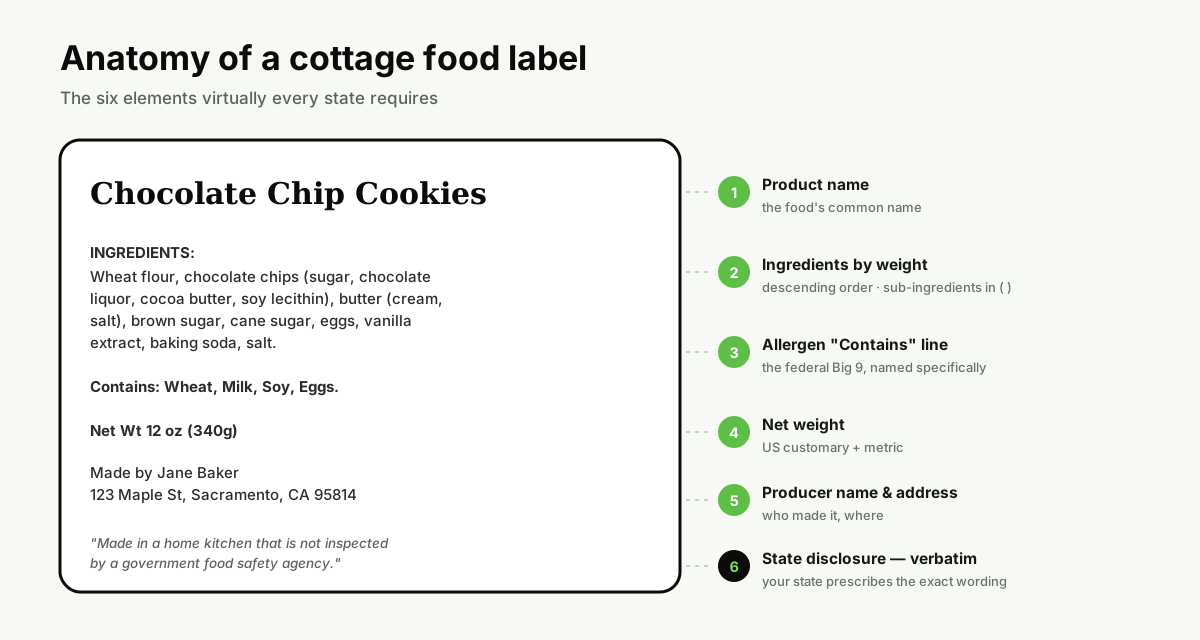
- Product name— the common name of the food (“Strawberry Jam”, “Chocolate Chip Cookies”).
- Your name and address — the producer or business name and the address where the food was made (some states allow a registration number instead of a street address).
- Ingredient list — every ingredient in descending order by weight, with sub-ingredients in parentheses (“chocolate chips (sugar, chocolate liquor, cocoa butter, soy lecithin)”) — same convention as commercial labels.
- Net weight or volume— in both US customary and metric units (e.g. “Net Wt 12 oz (340g)”).
- Allergen declaration — see below.
- The home-kitchen disclosure — a state-mandated statement along the lines of “Made in a home kitchen not inspected by the [state] Department of Health”. The exact wording, and sometimes minimum type size, is set by your state — copy it verbatim from your state’s program page.
Allergens: the part you cannot skip
Federal allergen law recognizes nine major allergens — milk, eggs, fish, crustacean shellfish, tree nuts, peanuts, wheat, soybeans and sesame (added by the FASTER Act) — and cottage food programs consistently require them to be identified, either by name in the ingredient list or in a “Contains:” statement right after it. Two details home producers miss:
- Be specificwith tree nuts and fish: “almonds”, “walnuts”, “cod” — not just the category.
- Hidden sources count: butter (milk), mayonnaise (egg), regular flour (wheat), chocolate chips (often soy lecithin, sometimes milk).
The Nutrillius generator auto-detects Big-9 allergens from your ingredient list and writes the Contains statement for you — worth using even if you only need the ingredient list.
What a complete cottage food label looks like
Here’s every required element assembled, for a fictional batch of chocolate chip cookies sold at a farmers market:
Chocolate Chip Cookies
INGREDIENTS: Wheat flour, chocolate chips (sugar, chocolate liquor, cocoa butter, soy lecithin), butter (cream, salt), brown sugar, cane sugar, eggs, vanilla extract, baking soda, salt.
Contains: Wheat, Milk, Soy, Eggs.
Net Wt 12 oz (340g)
Made by Jane Baker · 123 Maple St, Sacramento, CA 95814
“Made in a home kitchen that is not inspected by a government food safety agency” (use your state’s exact wording)
Note the details that trip people up: chocolate chips broken out into sub-ingredients (revealing the soy lecithin), butter’s milk source captured in the Contains statement, both US and metric net weight, and the disclosure in the state’s language rather than paraphrased.
Do you need a Nutrition Facts panel? Usually not — with 3 exceptions
Most state cottage food laws do not require a Nutrition Facts panel, and small producers selling in-state typically also fit FDA small-business exemptions. The three situations that change the answer:
- You make a nutrition claim.Put “low sugar”, “keto”, “high protein” or any nutrient claim on the label or listing, and a compliant panel is generally required to back it up.
- You sell across state lines(or through channels your cottage law doesn’t cover) — you’re now in standard FDA labeling territory.
- Your buyer demands it. Grocery buyers, coffee-shop wholesale accounts and some online marketplaces ask for a panel regardless of legal requirement.
Why many cottage producers add one anyway
A Nutrition Facts panel is the fastest visual signal that a product is “real”. Producers tell us it helps close wholesale accounts, justifies premium pricing at markets, and answers the “how many calories?” question before it’s asked. Since the cost via the database method is now a one-time $39 rather than a lab bill, the calculus has changed — you can look retail-ready from your first farmers market.
When you outgrow cottage food
The moment you move into a commercial kitchen, hire a co-packer, or ship interstate, full FDA labeling applies: the complete Nutrition Facts process with 21 CFR 101.9 rounding, RACC-based serving sizes and format rules. If your cottage label was built in a real generator, that transition is a re-export — not a redesign.
nutrillius · free to build
Make your cottage food label look retail-ready
Build the ingredient statement, allergen declaration and a full FDA-format Nutrition Facts panel from your actual recipe — free to build, $39 one-time when you're ready to print.
Create Label Now →No account needed · PNG · PDF · SVG from $39
Frequently asked questions
Do cottage food products need a Nutrition Facts label?
In most states, no — cottage food laws typically require an ingredient list, allergen information, net weight, your name/address and a home-kitchen disclosure, but nota full Nutrition Facts panel. The big exception: if you make any nutrition claim (“low sugar”, “high protein”), a compliant panel is generally required. Always confirm with your state’s cottage food program.
What allergens do I have to declare on a cottage food label?
The federal “Big 9”: milk, eggs, fish, crustacean shellfish, tree nuts, peanuts, wheat, soybeans and sesame. Declare them by name in the ingredient list or in a “Contains:” statement. Allergen labeling applies to cottage food in essentially every state — this is the part you can’t skip.
Why add a Nutrition Facts panel if my state doesn't require it?
Three reasons sellers do it anyway: retail buyers and markets often ask for one; customers trust products that look professionally labeled; and if you later move into wholesale or cross-state e-commerce you’ll need one regardless — building it early means your packaging doesn’t change when you grow. At $39 one-time, it’s cheap credibility.
Does selling online change my labeling requirements?
It can. Cottage food laws are state laws, and many restrict sales to within your state (some require in-person handoff). Shipping across state lines generally moves you into federally regulated territory — where standard FDA labeling, including Nutrition Facts (unless you qualify for a small-business exemption), applies. Check both your state program and FDA small-business exemption rules before shipping.
Keep reading
How to make a nutrition facts label
The full FDA process for when you're ready to go beyond cottage food.
Read →How much does a nutrition label cost?
Why the database method changed the math for home producers.
Read →FDA rounding rules — complete tables
What 'compliant numbers' actually means on a Nutrition Facts panel.
Read →The best nutrition label generators
All the tools compared, free options included.
Read →